ODESSA, Del. -- Feb. 17, 2026 -- When the Historic Odessa Foundation re-opens the doors to its 18th-century museum homes on March 1, the biggest change will not be immediately visible: a significant collection of historic objects has quietly “returned home.” In late 2025, Winterthur Museum, Garden & Library deaccessioned and transferred ownership of 44 artifacts to the foundation, deepening Odessa’s ability to tell its stories through objects that once again belong to the place they were made to serve. Included in the transfer are 33 objects previously on display at Odessa through a long-term loan agreement, plus 11 others that Winterthur owned and used for display and educational purposes in the Winterthur/University of Delaware graduate-study programs in conservation and American material culture.
For nearly 50 years, until 2005, the Historic Houses of Odessa, as they were then known, and the collections therein, were owned by Winterthur. That year marked a turning point when the Historic Odessa Foundation was formally established as a nonprofit organization, and Winterthur transferred ownership of six historic houses and approximately 5,000 objects from its collection to the foundation. The nationally recognized museum of American decorative arts had been gifted the properties and collections beginning in 1958 with Odessa’s Corbit mansion—now the Corbit-Sharp House (c. 1774), designated a National Historic Landmark in 1967, and a National Park Service Network to Freedom site in 2007 (the Historic Odessa District was placed on the National Register of Historic Places in 1971)—by noted Delaware preservationist H. Rodney Sharp (1880–1968). Mr. Sharp first set this preservation legacy in motion in 1938 with his purchase of the Corbit mansion and the start of a full-scale restoration of Historic Odessa, a legacy the foundation continues to honor, preserve, and promote today.
The recent collections transfer formalizes the status of artifacts that have materially shaped the period rooms of the foundation’s two principal historic houses in Odessa for decades—some displayed since they were donated or acquired in the 1970s, and others associated with the opening of the Wilson-Warner House in 1923 following Mary Corbit Warner’s death.
“The Historic Odessa Foundation Board of Directors and our entire organization are thrilled to welcome these remarkable family heirlooms home. Their return brings meaningful closure to yet another chapter of our storied past and deepens the way we can share Odessa’s history with the public,” said Debbie Buckson, executive director of the Historic Odessa Foundation.
“Winterthur is delighted to gift these objects to Historic Odessa, ensuring that these outstanding examples of American craft and material documents of history will remain within the sites where their histories can best be told,” said Chris Strand, Charles F. Montgomery Director and CEO, Winterthur Museum, Garden & Library.
Among the most story-rich additions now returning to Historic Odessa are two pieces of commemorative Liverpool creamware—a pitcher and a bottle, sometimes called a “guglet”—and a pair of fused-plate silver candlesticks made in Sheffield, England. Each ties directly to Ann Jefferis, who married Odessa merchant David Wilson Jr. in 1808, and to her father, Capt. James Jefferis.
Pottery that reads like a shipping record
The jug bears a transfer-printed image of a ship along with the words “SUCCESS TO THE BROTHERS/JAs. JEFFERIS, MASTER.” A Philadelphia newspaper recorded that the Jefferis’s ship the Brothers docked in Wilmington in September 1789.
The companion bottle links Jefferis to another ship, the Wilmington, on which he served as one of several captains over its decades of service. Printed on the guglet’s opposite side is “The Sweet Poll of Plymouth [England],” a reference to a popular sailors’ song dating to about 1786. Printed copies of the song were sold in Philadelphia and Baltimore for 25 cents, underscoring how seafaring culture traveled alongside trade goods.
Wedding silver, plus later additions that kept the initials alive
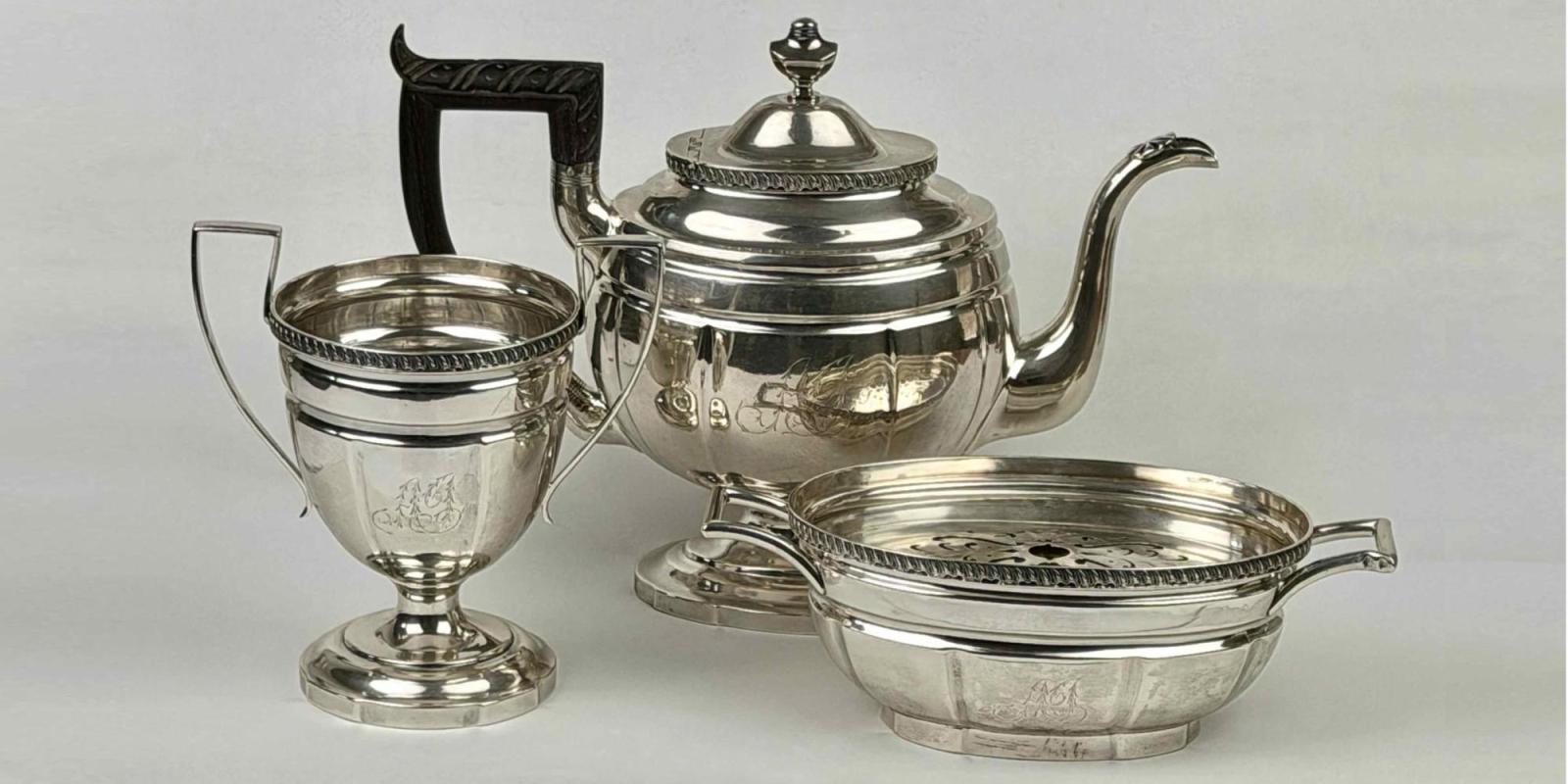
The fused-plate candlesticks—made with thin sheets of silver bonded to a copper core—bear Ann’s initials and are believed to have been among marriage gifts given when she wed Wilson in 1808. They now stand alongside other wedding-related objects tied to the family, including a hot-water urn and a silver three-piece coffee service with sugar tongs made by Wilmington silversmith Thomas McConnell. The sugar tongs are engraved “AJ” with the date of 1806 with later engravings added by MCW (Mary Corbit Warner), the granddaughter, that traces their family descent.
The story continues into the late 19th century: when Mary Warner owned that coffee service, she added a teapot, spoon vase, and butter dish made in Philadelphia in the 1880s, and had each piece engraved “AJ,” matching the earlier 1808 objects. The multigenerational, engraved silver service is now reunited with the other family silver in Odessa.
Long-term loans become permanent fixtures
The foundation said all objects on long-term loan from Winterthur since 2005 and on view in the Corbit and Wilson houses are now owned by the Historic Odessa Foundation. The transfers include major furnishings with documented ties to the Corbit family, such as the Corbit tall clock and a desk-and-bookcase in the dining room, both listed in William Corbit’s estate inventory;
two sets of three chairs in the parlor, also documented in the inventory; and a dressing table (lowboy) in the master bedroom.
Other highlights noted by the foundation include a labeled John Janvier tall chest, a labeled George Whitelock sideboard and a pair of card tables in the Wilson parlor, along with decorative arts and textiles such as a silk needlework picture wrought by Ann Jefferis Wilson and a quilt made by Mary Jane Moore Eastburn of Mill Creek Hundred.
The Wilson-Warner House—a Georgian-style home built circa 1769 to reflect David Wilson’s prosperity—stands next to the Corbit-Sharp House on Main Street in Odessa, where Historic Odessa Foundation interprets the adjoining properties and their collections for the public.
About Winterthur Museum, Garden & Library
Winterthur—known worldwide for its preeminent collection of American decorative arts, naturalistic garden, and research library for the study of American art and material culture— offers a variety of tours, exhibitions, programs, and activities throughout the year. Admission includes an introductory house tour, exhibitions, a narrated tram ride (weather and space permitting), and the Winterthur Garden.
Winterthur is located on Route 52, six miles northwest of Wilmington, Delaware, and five miles south of U.S. Route 1. Winterthur is committed to accessible programming for all. For information, including special services, call 800.448.3883 or visit winterthur.org. Winterthur is closed seasonally from early January through late February.
About the Historic Odessa Foundation
The Historic Odessa Foundation, established in 2005, owns and operates Historic Odessa, a 72-acre enclave of 18th and 19th century structures located in the town of Odessa in southern New Castle County, Del. The historic buildings and gardens along with a well-documented collection of more than 7000 objects and furnishings offer a unique picture of Delaware’s colonial period in a rural village that played a vital part in America’s commercial history. The town of Odessa, originally known as Cantwell’s Bridge, has retained much of its 18th century charm and is listed on the National Register of Historic Places and home to a National Historic Landmark, and two National Park Service Network to Freedom sites. Learn more at www.historicodessa.org.
201 Main Street, DE. 19730 / 302-378-4119