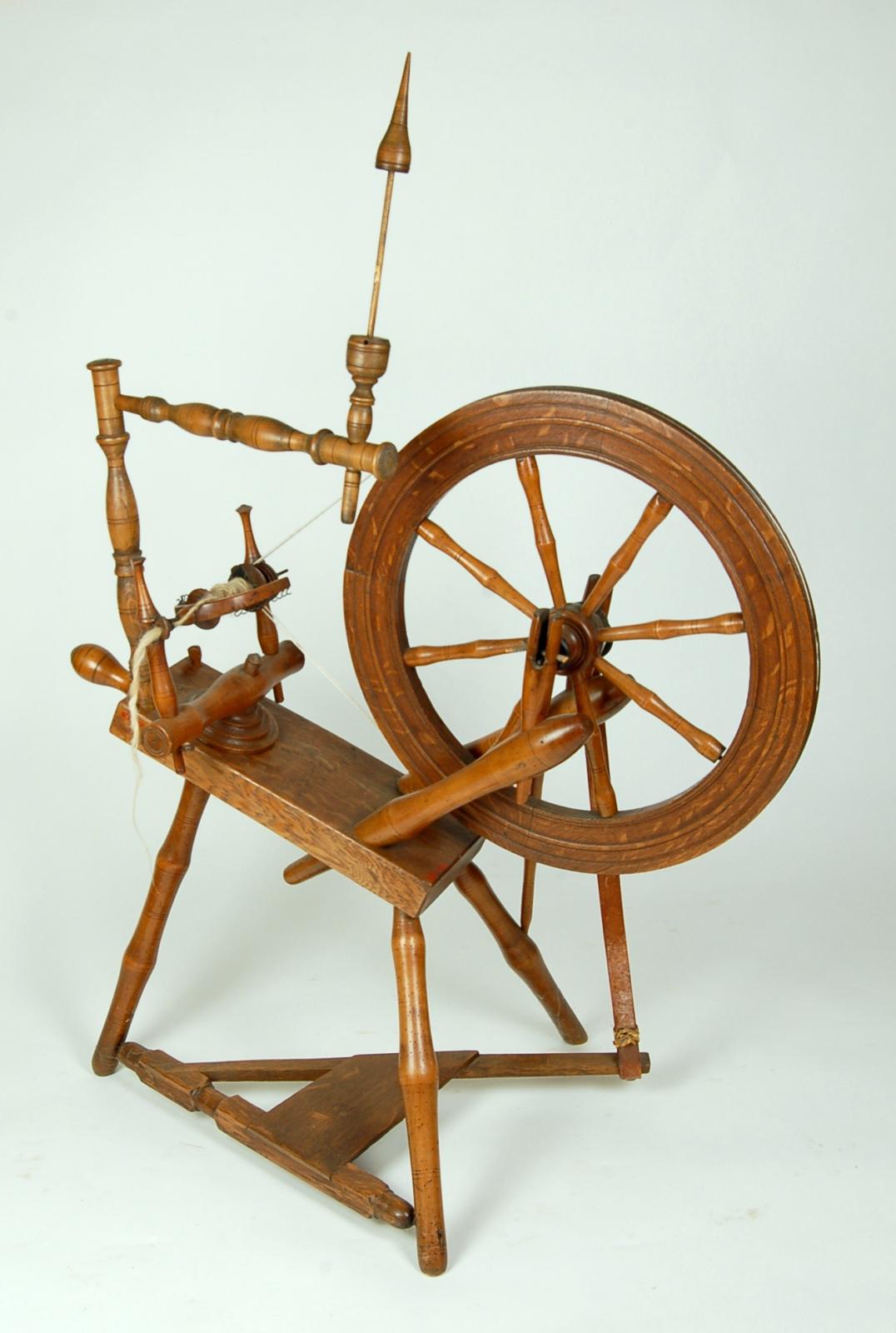
Flax wheel
Northeastern United States
1775-1810
Maker
J. Johnson (dates unknown)
Measurements
47 in x 32-1/2 in x 19-3/4 in
Materials
Maple* (all turnings) oak (wheel rim, platform or "table," and all parts of the treadle)
Credit Line
Historic Odessa Foundation
Accession Number
1968.402
Inscription
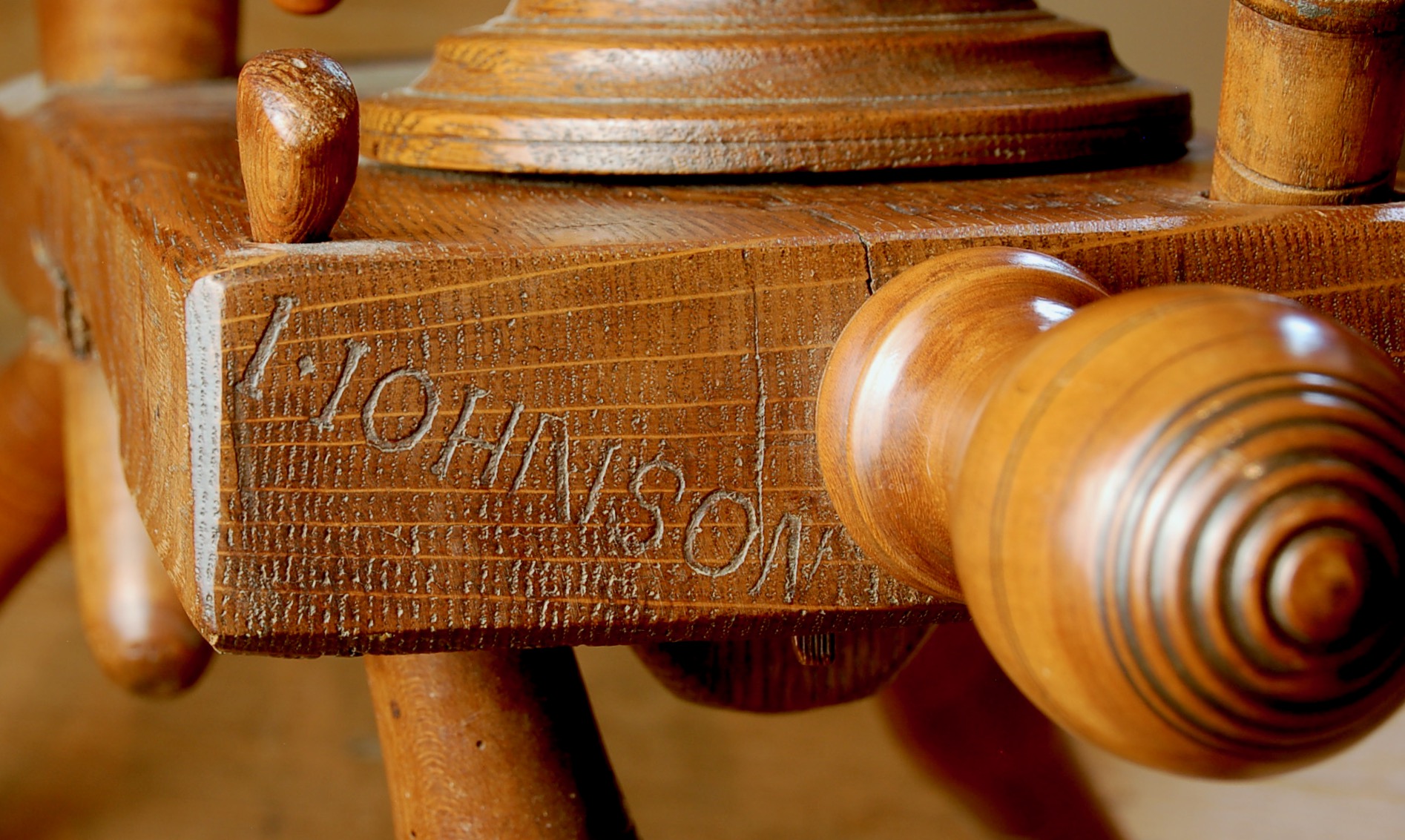
“I·JOHNSON” is stamped into one end of the oak platform or table.
Condition Notes
Some evidence of wormholes (now inactive) exists in one leg. The distaff likely comes from another source.
Provenance
The flax wheel was acquired from Mrs. W. Edward (Elizabeth C.) Wright of Wilmington, Delaware. See "Comments" for additional information.
Comments
This flax wheel, and type of spinning wheel, was used to spin (i.e., twist) the fibers of flax into thread--a complex and laborious process. Flax wheels were made by turners, who also made wheels and other useful equipment. The design of flax wheels did not change much from place to place and from time to time. This wheel bears the name of its maker stamped into the end of the table. Although J Johnson has not been identified, use of the letters "I" in place of the "J" suggest a likely date before about 1800. Most surviving flax wheels were made sometime during the 19th century.
A report of August 30, 1968, written by Odessa curator Horace Hotchkiss assigned an Odessa provenance to this flax wheel based on its acquisition from Mrs. Wright along with a pembroke table (accession no. 1968.401). She applied a label to the table stating that it was owned by Isaac Janvier Wood (1863-1931) on McDonough, Delaware. Independent evidence has not affirmed this provenance for the flax wheel.
The turned maple parts on this wheel are decorated with groups of three score rings around the wider diameters of the turned part. However, the maple on the distaff--a stick around which flax was wound--is a slightly different color, and it has pairs of score rings. It likely came from another source. It anchors to the thick oak table by fitting the tapered end into a tapered hole, enabling parts from one wheel to work on another.
Bibliography
Zimmerman, A Storied Past, cat. no. 19, pp. 95-96.