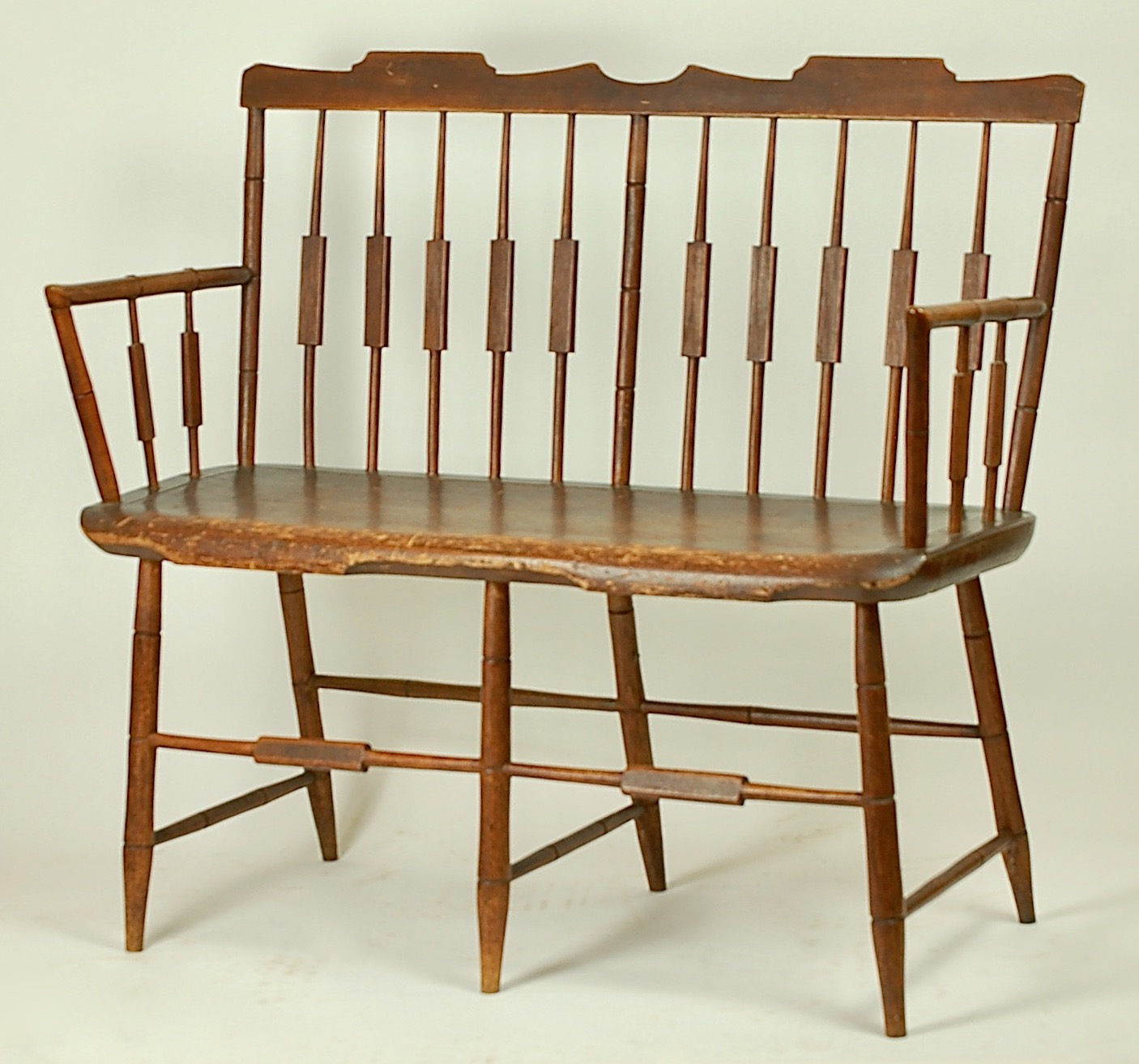
Tablet-top Windsor settee
Baltimore, Maryland, or Philadelphia, Pennsylvania
1810-1820
Measurements
36-3/8 in x 39-3/4 in x 17-1/8 in
Materials
Tulip poplar* (seat and crest), red maple* (arms, arm supports, and stretchers), hickory* (legs, spindles, and posts)
Credit Line
Historic Odessa Foundation, gift of H. Rodney Sharp
Accession Number
1959.3627
Provenance
Ex coll. H. Rodney Sharp
Comments
The extra work on this tablet-top settee, so-called for the crest that sits atop the three rear posts defining seating places for two people, makes it a joy to behold. The crest rail has rectangular masses set upon a line that sweeps upward at each side. The spindles in the back and under the arms have rectangular medallions worked into their centers that create a visual rhythm echoed in the front stretchers. All of the round elements are grooved in imitation of bamboo, and the front edge of the plank seat is modeled into downward curves for each sitter.
Windsor historian Nancy Evans firmly identified this settee as Baltimore, but the presence of at least two chairs--a side- and an armchair--with the brand of Isaac Bird, working in Philadelphia from about 1810 to 1815, argue the possibility of Philadelphia fabrication. The two cities had close working relationships, and further research is needed to more fully sort the products of each. The stamped Bird side chair is in Evans, American Windsor Chairs, 136.
Bibliography
Nancy Goyne Evans, “Design Transmission in Vernacular Seating Furniture: The Influence of Philadelphia and Baltimore Styles on Chairmaking from the Chesapeake Bay to the ‘West,’” in American Furniture 1993, ed. Luke Beckerdite (Milwaukee, Wisc.: The Chipstone Foundation, 1993), 88-89, fig. 14.
Nancy Goyne Evans, American Windsor Furniture: Specialized Forms (Hudson Hills Press, 1997), 120.