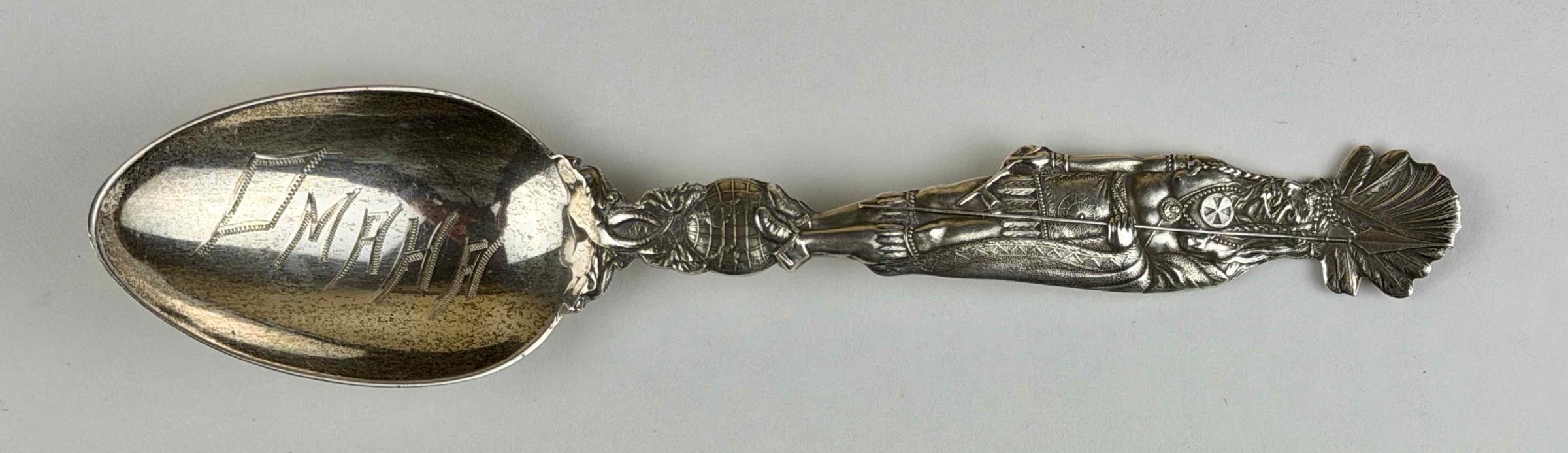
Souvenir spoon: Omaha
Brooklyn, New York
1898
Maker
George W. Shiebler & Co (1876-1910)
Abraham Mandelberg, retailer (1856-1929)
Measurements
6-1/8 in x 1-3/8 in x 7/8 in
Materials
Silver
Credit Line
Historic Odessa Foundation, The David Wilson Mansion, Inc.
Accession Number
1971.1053
Inscription
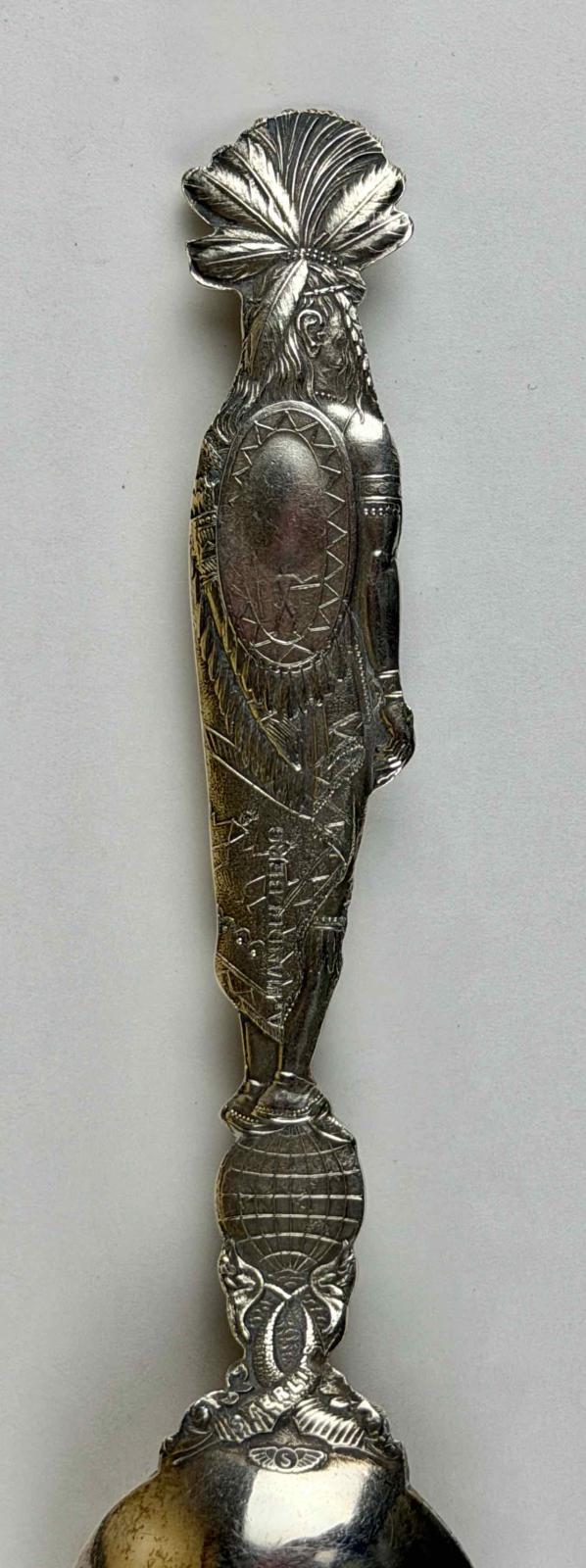
“OMAHA” is engraved in the bowl. “A. MANDELBERG” is in relief on underside of the handle along the bottom of the Indian’s robe. “STERLING” is in relief at the base of the handle on the underside. “S” within a wing device is at the base of the handle.
Provenance
Ex coll. Mrs. E. Tatnall (Mary Corbit) Warner
Comments
The spoon handle is a finely cast representation of an Indian wearing a feather headdress, several pendants around his neck, a robe, and other paraphernalia. He stands on a globe. The globe likely symbolizes the Omaha World’s Fair, officially called the Trans-Mississippi and International Exposition held in 1898. It showcased Western United States achievements from the Mississippi River to the Pacific Ocean.
In 1899, the Greater America Exposition was also held in Omaha as a successor to the 1898 World’s Fair and on the same site. Less all-encompassing that the 1898 fair, it was intended to celebrate U.S. territorial gains around the world (Philippines, Puerto Rico, and Hawaii) following the Spanish-American War of 1898. It was not as successful.
Abraham Mandelberg of Baltimore was a jeweler in Omaha who subsequently moved to New York City to work for the New York Times in 1917. He commissioned the souvenir spoon of the prominent George W. Shiebler & Co. of Brooklyn, a business that challenged Tiffany and other fine fabricators for dominance in the field. He likely commissioned the spoon in time for the 1898 fair.
Bibliography
Accumulation & Display: Mass Marketing Household Goods in America, 1880-1920 (The Henry Francis du Pont Winterthur Museum, 1986), no. 199, pp. 142-143.