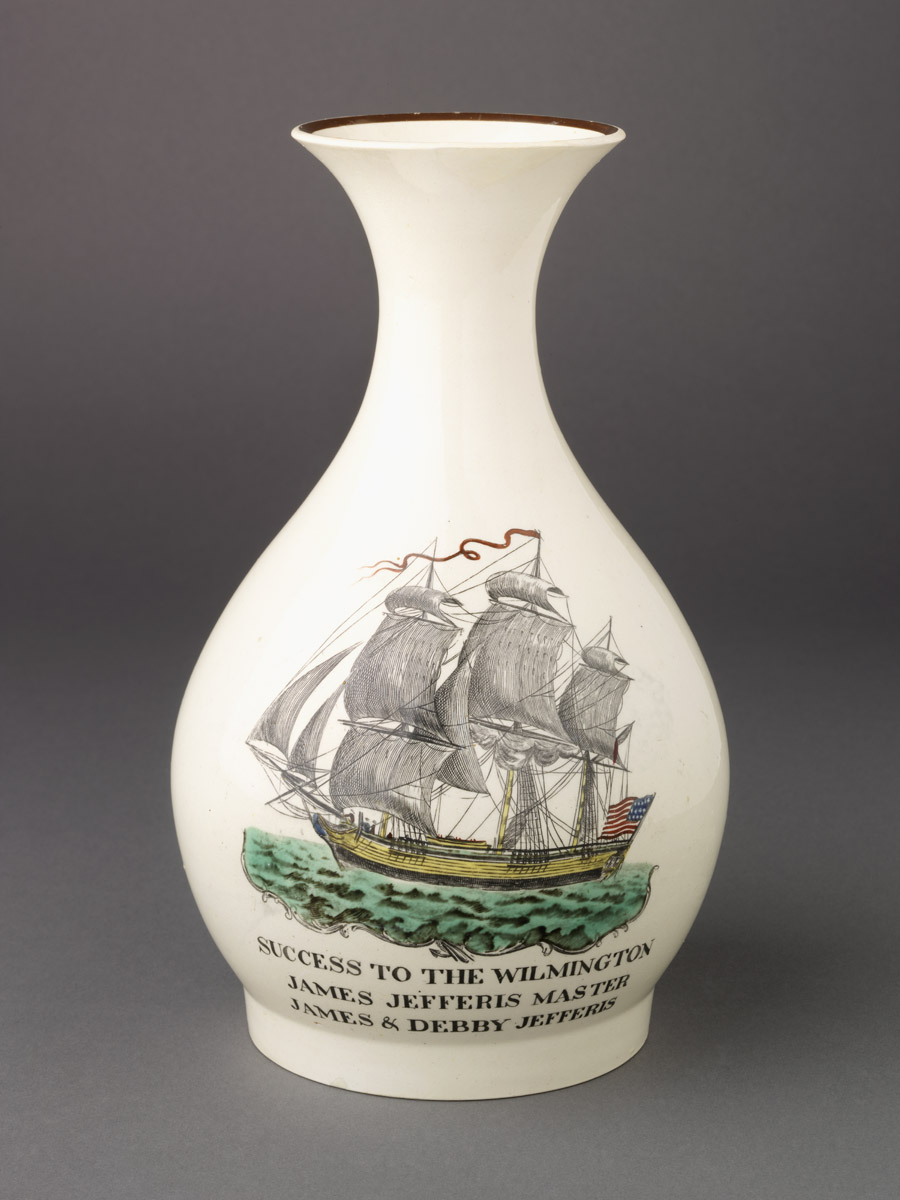
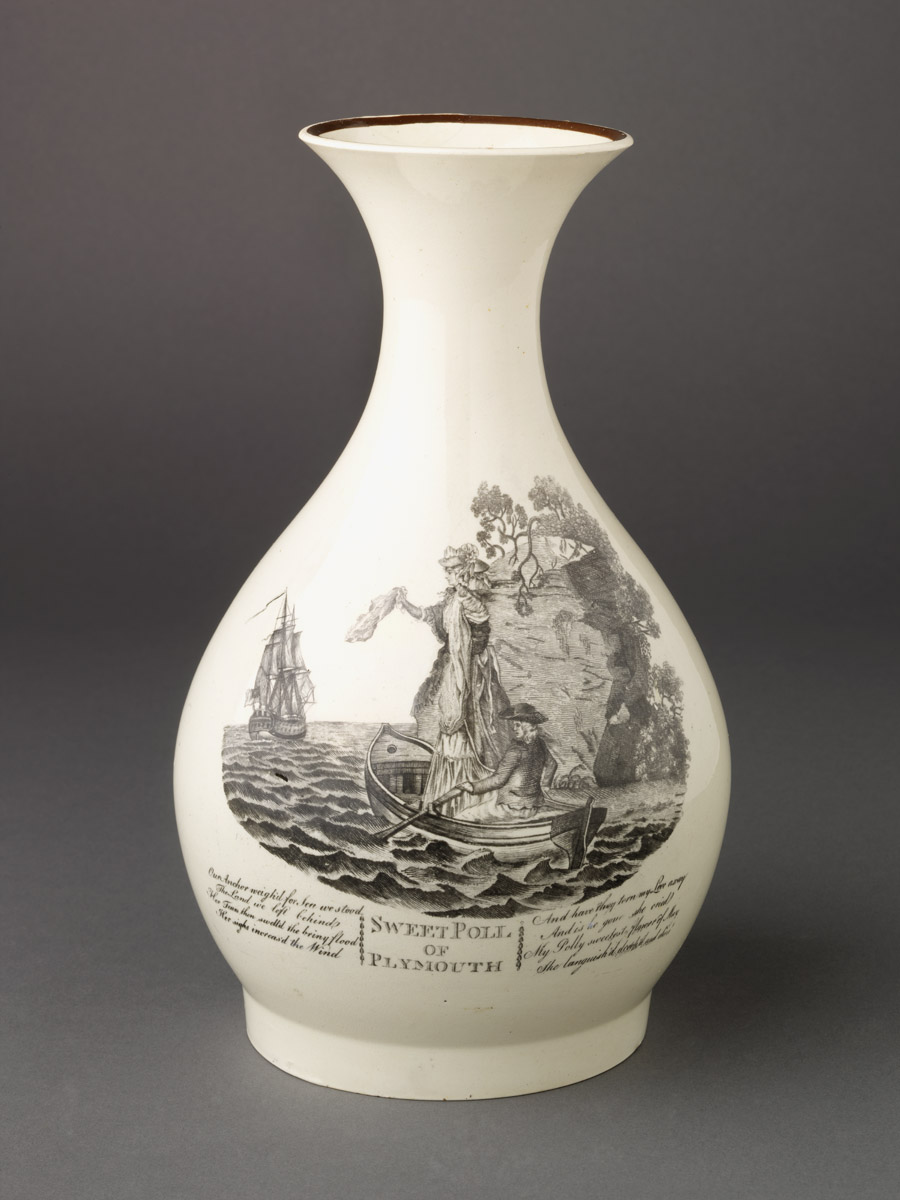
Bottle (guglet)
Liverpool, England
1790 to 1795
Measurements
9-1/2 in x 6 in (dia)
Materials
Transfer-printed white earthenware (creamware)
Credit Line
Historic Odessa Foundation, The David Wilson Mansion, Inc.
Accession Number
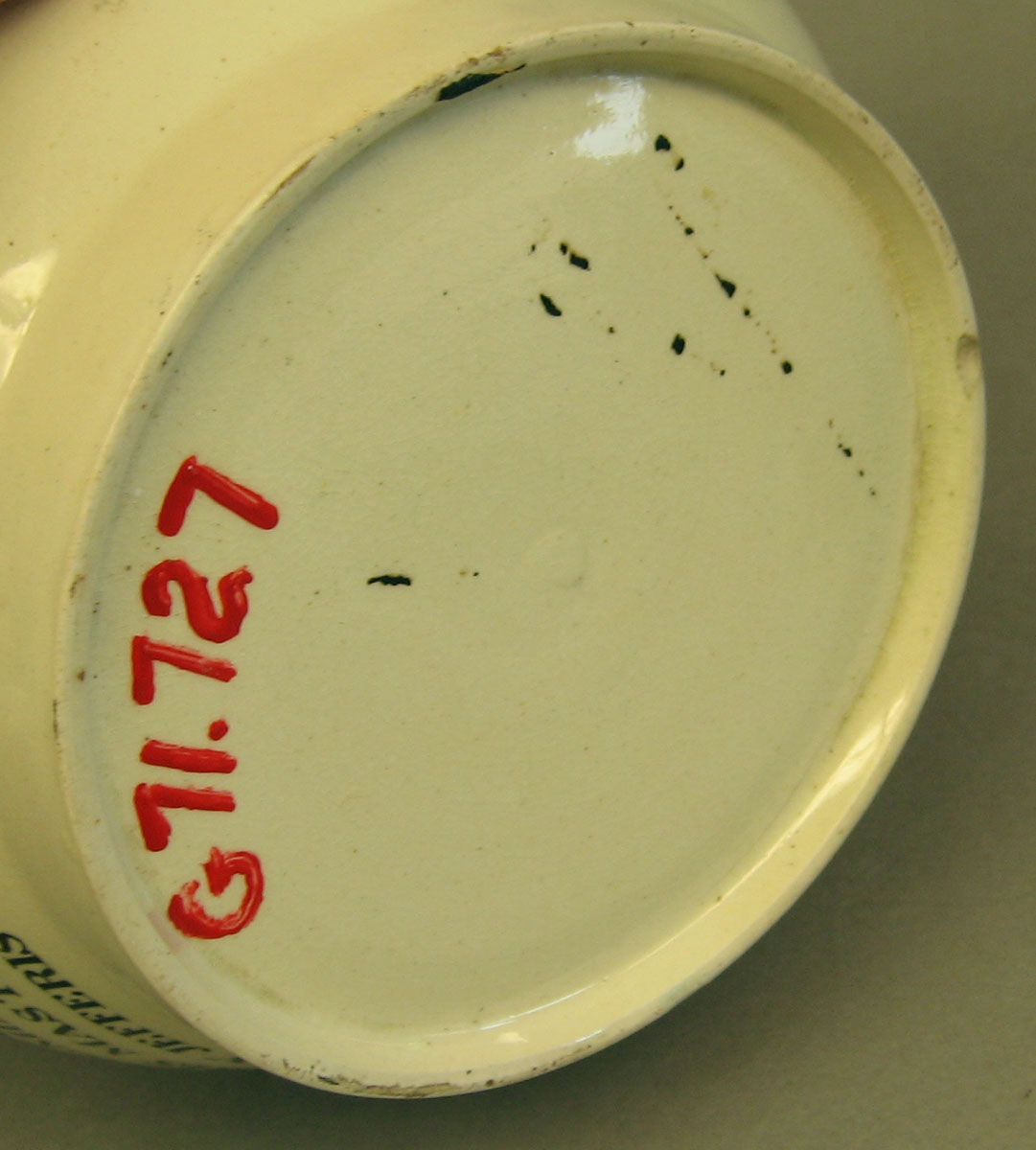
1971.727
Inscription
Inscription: “SUCCESS TO THE WILMINGTON / JAMES JEFFERIS MASTER / JAMES & DEBBY JEFFERIS”
“SWEET POLL / OF / PLYMOUTH” and “Our Anchor weigh'd for Sea we stood / The Land we left behind / Her Tears then swell'd the briny flood / Her sighs increas'd the Wind” and “And have they torn my Love away / And is he gone she cried / My Polly sweetest flower of May / She languish'd droop'd and died”
Condition Notes
The rim has a stress crack. A large chip in the rim has been restored. The outside edge of the base has small fills.
Provenance
Ex coll. Mrs. E. Tatnall (Mary Corbit) Warner
Comments
The baluster-shaped bottle or vase bears several transfer-printed decorations. One side, showing a polychromed three-masted ship flying the American flag, incorporates the inscription “SUCCESS TO THE WILMINGTON / JAMES JEFFERIS MASTER / JAMES & DEBBY JEFFERIS.” Like a pitcher, accession no. 1971.726, the bottle can be reliably documented to Ann Jefferis’s father, Capt. James Jefferis (c. 1758–1822). The accession number indicates that it was on-site at the Wilson-Warner House and part of the 1968 David Wilson House-Winterthur merger.
The "Wilmington" was a merchant ship that had multiple captains, one of whom was Jefferis. According to Philadelphia Customs records, the ship was launched about 1790, captained by Jefferis at that time, and remained in service until the beginning of the 19th century. The "Wilmington" is also depicted in a Liverpool platter of 1796-1797 at Winterthur (accession no. 1964.1176), when it was captained by Robert Shields.
The verse recorded on the side opposite the ship refers to a song entitled "Sweet Poll of Plymouth," about a young woman separated from her sailor beau. The earliest records of that song seem to date from about 1786. A few engravings of the late 1780s or early 1790s show a young woman watching as a ship leaves for sea, as represented on the bottle. By about 1795, "Sweet Poll" was associated with another woman, both presented as prostitutes in a brightly colored caricature or cartoon. This more common print signals the end of anything sweet or desirable concerning Sweet Poll, although the sailor's song may have remained popular.
Bottles of this shape and purpose were sometimes called guglets.